
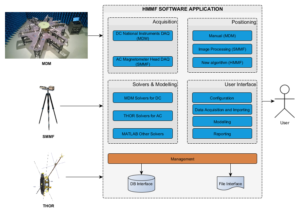
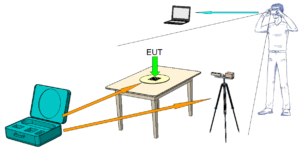
 The technical objective of this activity is to improve various tools that are currently used for magnetic cleanliness applications both for DC and AC magnetic field measurements. This includes modifications to the Suitcase Multi-Magnetometer Facility developed in the frame of AO/1-8770/16/NL/SC so as to be adapted to current proto-MMF facility (today installed at ESTEC labs) and manufacturing of four (4) Magnetic Field Measurement Heads (SMS-DAQ/MAG) units to be delivered to the Agency.
Another objective is to upgrade current software tools used for data acquisition and modelling purposes in proto-MMF in order to perform AC measurements but also to interface with AC modelling tools towards a unified software application for DC and AC magnetic field measurements in proto-MMF and S-MMF. The activity also includes the development of a new algorithm to define the magnetometers positions of proto-MMF based on known magnetic field.
Principal objective is also to integrate all the above separate improvements and validate their operation and performance. In this way we expect to provide flexibility to EMC engineers to perform DC and AC magnetic field measurements in EUTs using common tools, both hardware and software.
Customer: ESA/ESTEC – European Space Research and Technology Centre
Prime Contractor: EMTECH SPACE P.C (CY) Ltd.
 DC Magnetic cleanliness is one of the most important applications employing an accurate prediction of any EUT’s magnetic behaviour. In addition, several space missions, such as the European Space Agency (ESA) Solar Orbiter mission, intend to make AC magnetic field measurements. Since these measurements require high accuracy and precision, it is extremely important to take place at “magnetically clean” environments, free of spacecraft noise at the deployed sensor locations. Further missions with similar cleanliness requirements are JUICE and THOR.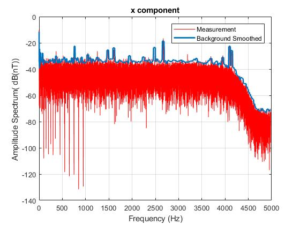
 SpaceWire (SpW) data distribution protocol for connecting instruments, mass-memory, processors, downlink telemetry, and other on-board sub-systems became an ideal solution for many space missions in terms of speed, power, simplicity, implementation costs and architectural flexibility.
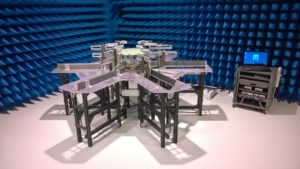 The need for “magnetically clean spacecraft” was the motivation for this study. The spacecraft residual magnetism should be kept below requirements determined by the scientific application and commensurate with the sensitivity (resolution) of on-board magnetometers. The study was driven by the need of more accurate and efficient testing of spacecraft equipment/units to provide a better estimation of the residual spacecraft magnetic field using MDM (Magnetic Dipole Modelling) techniques which are further optimized by the use of deterministic and randomized methods.